What is a Bridge Rectifier?
If you’ve never heard that term before, even as somewhat of an electronics buff, you’re far from alone. Bridge rectifiers are modest, rarely discussed components that are absolutely critical for powering all our favorite devices.
Simply put, they’re the parts that ensure devices receive a steady stream of energy and essentially form the backbone of most power supply circuits.
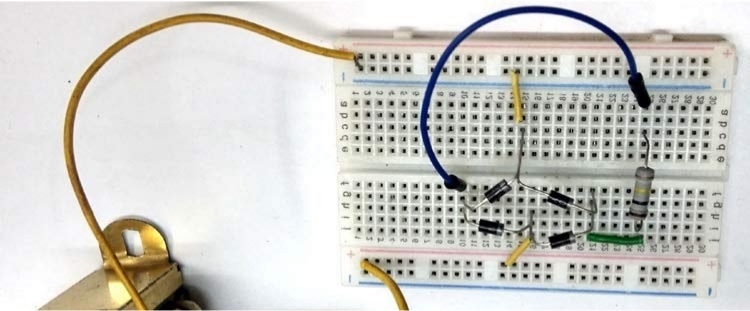
To be more technical, though, a bridge rectifier is actually an arrangement of four diodes in a particular bridge configuration that provides the same polarity of output for either polarity of the input. Its primary function is to convert alternating current input into direct current output, the need for which stems from the fundamental differences between AC and DC.
You see, AC is characterized by quickly changing voltage and direction - great for power transmission over long distances but bad for the average device. After all, most of the electronics we use day in and day out call for stable, unidirectional flow of DC to operate correctly. This is where the bridge rectifier shines, ensuring that the alternating waves of AC are transformed into a consistent and usable DC output.
How Bridge Rectifiers Work
Want to dive a little deeper into the science behind it all? To truly get it, you first need to understand a couple of basics about diodes and AC signals.
The first of these is that diodes - semiconductor devices we’ve talked about here before - allow current to flow in one direction only, from the positive side (or anode) to the negative side (or cathode). When a diode is forward-biased (positive voltage at the anode), it conducts electricity. But when it is reverse-biased (negative voltage at the anode), it refuses to let power flow, blocking electricity.
The second important piece of info to know is that AC signals alternate in polarity. In layman’s terms, this means that the voltage periodically reverses direction.
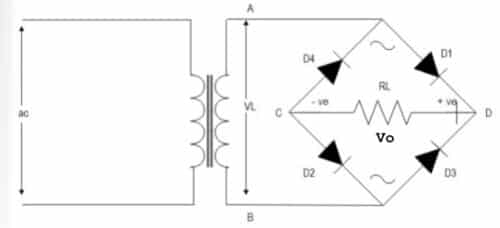
Typically, an AC waveform consists of positive and negative half-cycles. In a bridge rectifier, four diodes are arranged in a diamond shape, forming two pairs that conduct during opposite half-cycles of the AC input. By rectifying both halves of the AC cycle, the bridge rectifier basically doubles the frequency of the output voltage ripple compared to a single diode or half-wave rectifier. This results in a smoother DC output, which can then be further smoothed using capacitors or other filtering methods.
Having a bit of trouble working through it all? Here’s a short summary of what exactly happens during both phases of AC input:
l AC Input Phase 1: During the positive half-cycle of the AC input, two of the diodes (D1 and D2) become forward-biased, allowing current to pass through. The current flows through the load resistor (connected across the output), producing a positive voltage. Meanwhile, the D3 and D4 diodes are reverse-biased and thus don’t conduct electricity.
l AC Input Phase 2: During the negative half-cycle of the AC input, the diodes that were previously not conducting become forward-biased while D1 and D2 become reverse-biased. This then allows current to flow through the load resistor in the same direction as in the positive half-cycle, ensuring the output voltage remains positive. The result? AC is effectively converted to DC! The output voltage, however, is pulsating DC, which can be further smoothed using capacitors or other filtering methods to achieve a more stable DC output.
Types of Bridge Rectifiers
While bridge rectifiers as a category share a great deal of commonalities, they’re not one-and-done kind of devices. Indeed, they come in a wide range of forms, several types/configurations available to meet the diverse need of specific applications.
Each of these possesses unique characteristics plus varying efficiency, stability, and control levels, so things can get rather specific! Rest assured, though, we’re not going to waste a ton of your time delving into the minutia. Instead, we’re going to focus on three configurations that we think every electronics engineer should know about: single-phase, three-phase, and fully controlled bridge rectifiers.
Single-Phase Bridge Rectifier
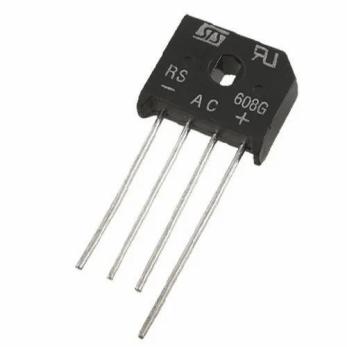
Simultaneously the most simplistic type of bridge rectifier and perhaps the most common, single-phase bridge rectifiers are widely used in low-power applications. These tiny electronics feature a very straightforward design, consisting of four diodes arranged in a compact and efficient diamond layout, which makes implementation in all sorts of circuits a breeze.
This type of bridge rectifier may be basic, but it still does some remarkably clever stuff. One great example of this is that single-phase bridge rectifiers actually utilize both halves of the AC cycle - a seemingly small design trick yet one that achieves much higher efficiency than other, more niche options like half-wave rectifiers. In turn, this enables smoother DC output, although it also brings several other benefits, including improved overall consistency, a reduction in manufacturing/purchasing costs, and better operation of sensitive devices.
Three-Phase Bridge Rectifier
Where the single-phase bridge rectifier excels in low-powered environments, the three-phase is best designed for high-power situations and industrial use. Why? It converts three-phase AC input into a more stable DC output, further increasing efficiency. Crucial for high-powered applications where energy conservation and stability are paramount, this, in turn, helps it operate in heavy-duty use cases that would otherwise be too hostile or difficult for other bridge rectifiers to handle.
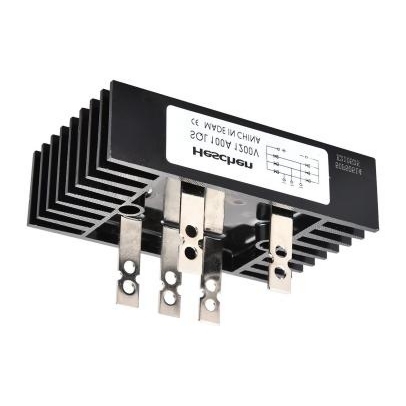
Besides this, three-phase bridge rectifiers also experience significantly less output voltage ripple than single-phase alternatives. Without as much ripple, they’re ideal picks for applications that require a stable and clean DC signal. Of course, three-phase bridge rectifiers are generally built to handle higher currents and voltages, too, making them a no-brainer for industrial use.
Robust construction ensures reliability and longevity, even in demanding environments. However, the design and implementation of a three-phase bridge rectifier isn’t without their downfalls, namely that they’re way more complex than those of a single-phase rectifier. This complexity arises from the need to manage three-phase AC inputs and ensure proper synchronization of the diodes but does unfortunately increase costs and somewhat restrict what these bridge rectifiers can be used for.
Fully Controlled Bridge Rectifier
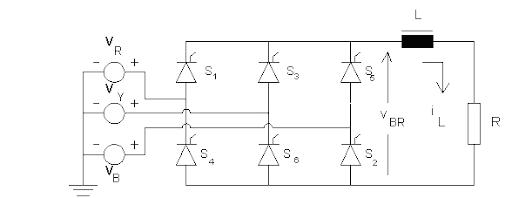
Although technically a type of three-phase bridge rectifier, fully controlled variants do something quite a bit different than their more traditional counterparts: they actually incorporate thyristors into their design. That may sound odd, although it can be a considerable advantage, granting fully controlled bridge rectifiers extremely precise control (as you’d expect!) over output voltage and great versatility. In addition, this unusual component composition enables phase control, a capability particularly useful in applications where power demand varies over time.
Unsurprisingly, the adjustable nature of fully controlled bridge rectifiers is usually a really good thing. It guarantees that they can be used in a wider range of applications, handle those that demand precise power management, and find a place in even the most specialized electronics. That being said, it brings some negatives as well, such as limiting switching speed and hurting power efficiency.
- 1.
What is a Bridge Rectifier?
Simply put, they’re the parts that ensure devices receive a steady stream of energy and essentially form the backbone of most power supply circuits.
 Paul George
Richard Electronics guest author, a Mechatronics engineer and a professional researcher, designer, developer and manufacturer for 3d Cad and PCB. I believe in efficiency, effectiveness and quality of work, and my aim is to provide complete one-roof solutions to complex mechanical and electrical design systems. I have a well-equipped lab with state-of-the-art technology for doing research and providing.


28 November 2025
25 October 2025

25 September 2025

16 August 2025
10 July 2025